TL;DR
AI nudges via WhatsApp helped save $2,400 in 6 months by catching overspending in real time, flagging forgotten subscriptions, and sending timely reminders before impulse purchases. No willpower required.
Start free →I Saved $2,400 in 6 Months Using AI Nudges
No spreadsheets. No budgeting app I opened once and forgot. Just small, well-timed messages that changed how I spend.
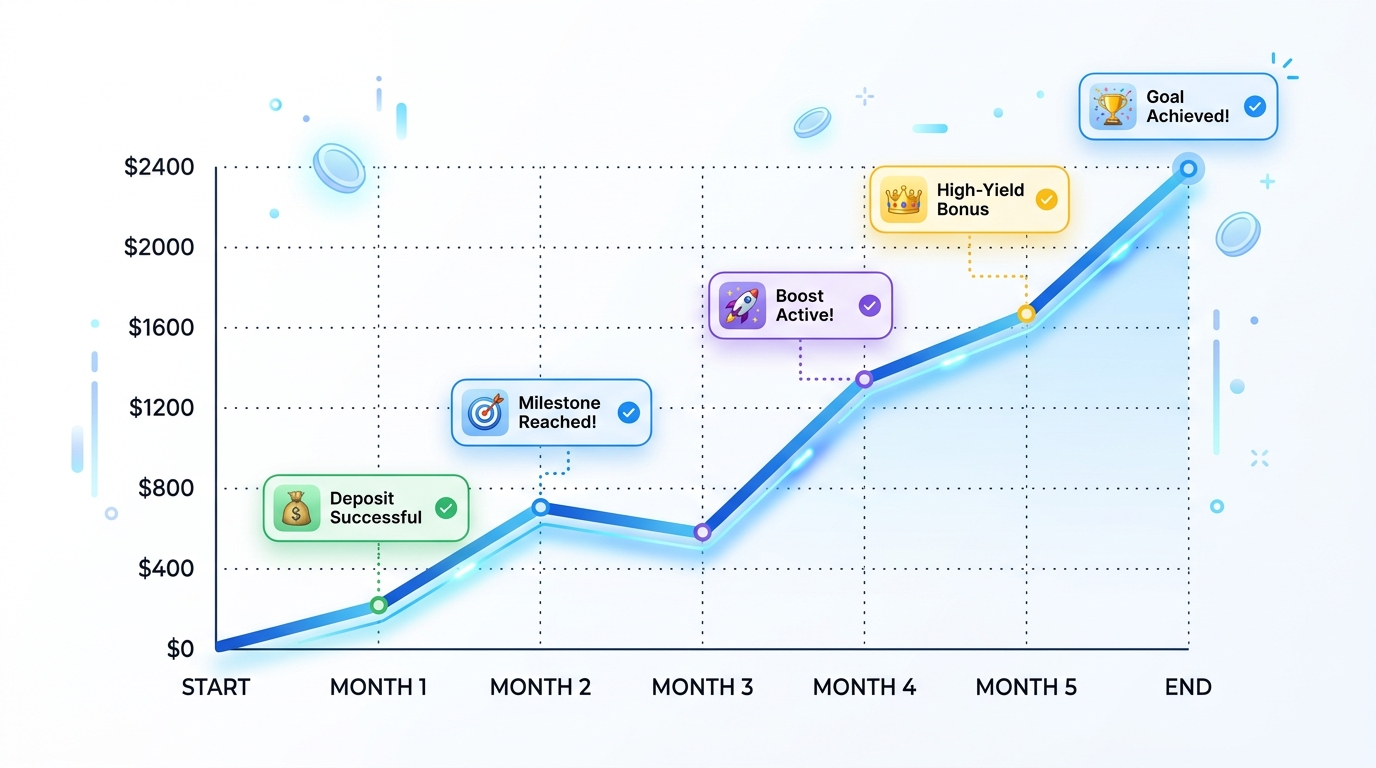
I used to think I was "pretty good" with money. I earned a decent salary, never carried credit card debt, and had a vague sense of where my money went each month. But when I actually tracked everything for the first time — truly tracked it — I discovered I was leaking over $400 a month on things I barely noticed. A subscription I forgot about. Coffee runs that added up to $180 a month. Three different streaming services when I only watched one.
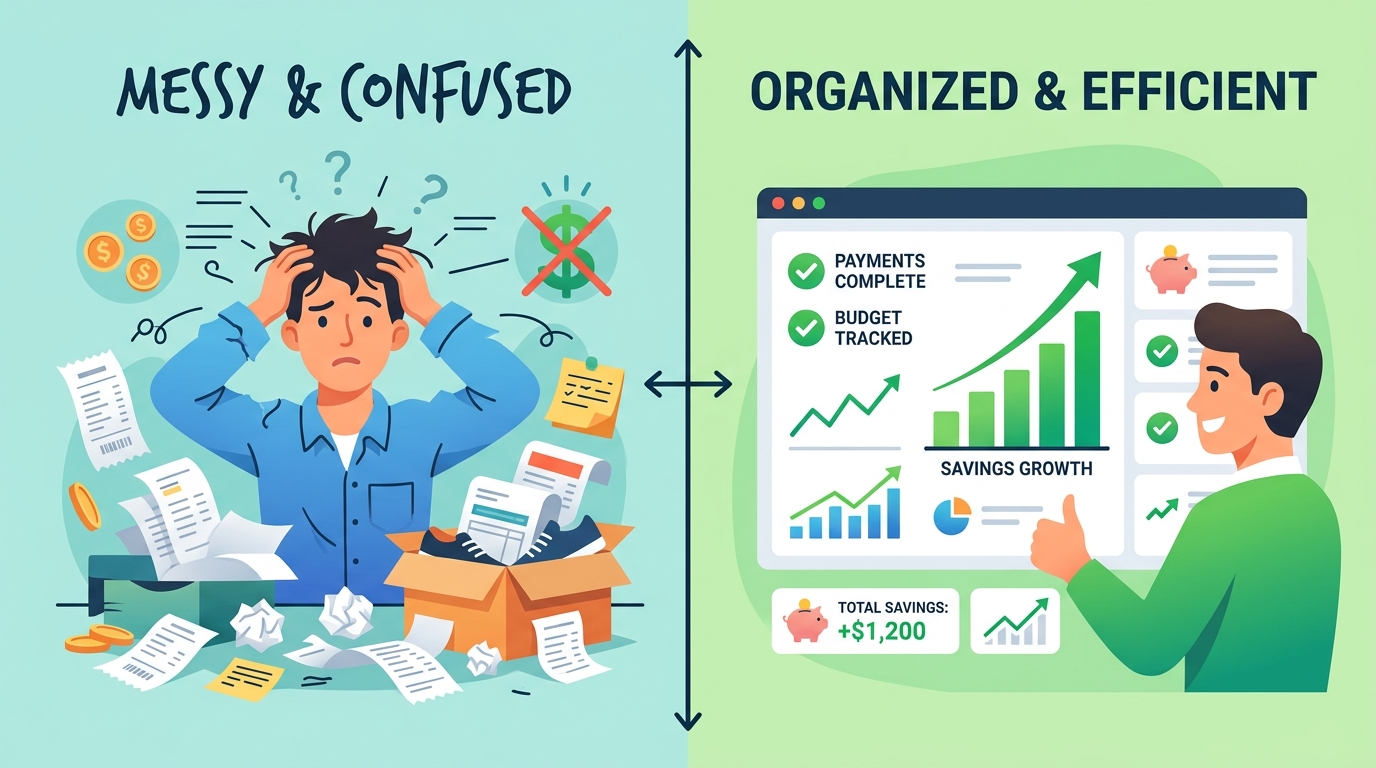
The problem was never knowledge. I knew I should spend less. The problem was timing. By the time I reviewed my bank statement at the end of the month, the money was already gone. I needed something that would catch me before I spent, not after.
That is when I started using AI nudges — small, automated messages sent to my WhatsApp at exactly the right moment. Six months later, I had saved $2,400 without feeling deprived or following a strict budget. Here is exactly how it happened.
What Are AI Nudges, Exactly?
An AI nudge is a context-aware notification from an AI money management tool that arrives at the moment it matters most. Not a generic "you spent too much this month" email on the 30th. Not a push notification you swipe away. A targeted, specific message based on your actual spending patterns, delivered where you already live — your messaging app.
There are three types that made the biggest difference for me:
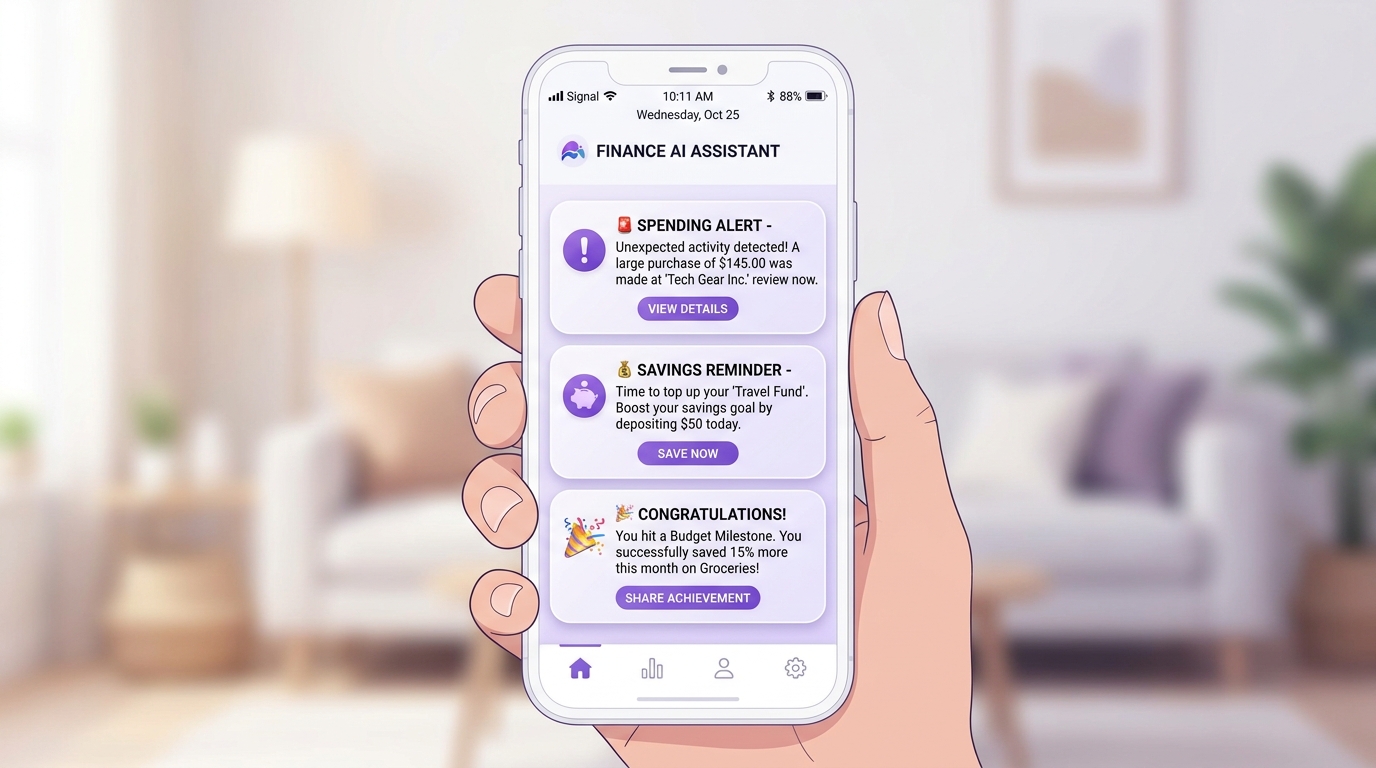
- Pre-spend nudges. "You have already used 78% of your dining budget this week. You have 3 days left." This hit my WhatsApp on a Thursday afternoon — right before I would normally order delivery for the third time that week. I cooked instead.
- Pattern alerts. "Your ride-share spending has increased 45% this month vs. your 3-month average." I had no idea. I had started taking Ubers to the gym because it was raining, and never noticed the habit forming.
- Savings milestones. "You just hit $500 saved this month — your best month yet." Positive reinforcement at the right moment made me want to keep going, not quit.
The key insight is that nudges work because they operate at the decision point, not the review point. By the time you sit down to look at a spreadsheet, every spending decision for the month has already been made. A nudge reaches you while there is still time to choose differently.
Get AI nudges on WhatsApp — no app download needed.
Track spending via message and receive smart nudges that help you save. Free tier includes unlimited AI categorization.
Start free →The 6-Month Savings Journey: A Monthly Breakdown
I did not save $2,400 evenly across six months. The first month was messy. The middle months felt like a breakthrough. And the final months ran almost on autopilot. Here is how it actually went:
Month 1: The Awareness Shock — $127 Saved
The first month was mostly about discovery. I started logging every expense via WhatsApp — just sending a quick message like "coffee 4.50" or "uber 12" whenever I spent money. The AI categorized everything automatically and started learning my patterns.
The first nudge that stopped me cold: "You have spent $94 on coffee shops in the last 14 days." I thought I was spending maybe $30-40. Seeing the real number, at the exact moment I was about to order another latte, made me put my phone away and use the office coffee machine instead.
I also discovered two forgotten subscriptions totaling $27 a month — a meditation app I used twice and a cloud storage upgrade I no longer needed. The AI flagged them as hidden money leaks within the first week.
Month 1 total saved: $127 (mostly subscription cancellations and reduced coffee spending).
Month 2: Pattern Interruption — $289 Saved
This is when the AI started getting genuinely useful. It had two months of data and began identifying patterns I could not see myself.
The biggest one: weekend spending spikes. Every Friday and Saturday, my spending jumped 3x compared to weekdays. The AI started sending a nudge on Friday mornings: "Last weekend you spent $185. Your budget allows $120 for the weekend. Plan ahead?"
I did not stop going out. But I started making small adjustments — pre-gaming at home instead of buying the first three rounds at the bar, choosing the restaurant with the prix fixe menu instead of the a-la-carte place. These were not sacrifices. They were slightly better decisions, made because I had the right information at the right time.
The AI also noticed I was spending $65 a month on a gym membership but taking Ubers to get there (another $80-90 a month). The combined cost of "fitness" was $145+, which I would never have connected without the pattern alert. I switched to a gym within walking distance — slightly less fancy, but $40 cheaper, and zero transportation cost.
Month 3: The Compound Effect — $384 Saved
By month three, something shifted. The nudges were not just preventing bad decisions — they were reinforcing good ones. The gamification elements kicked in: daily missions, savings streaks, and milestone celebrations made me actively want to check in.
I hit a 21-day streak of staying within my daily spending target. When the AI sent "21-day streak — your longest ever. You have saved $92 more than last month at this point," I felt an actual dopamine hit. That is behavioral design working as intended.
The AI also started making predictive suggestions: "Your car insurance renews in 12 days ($890). Based on current cash flow, consider setting aside $45/day to absorb it without dipping into savings." I had completely forgotten about the renewal. Without that nudge, it would have hit my account as a surprise and derailed my whole month.
Month 4: Cruise Control — $471 Saved
Month four was when the effort-to-savings ratio flipped dramatically. I spent less time thinking about money, but saved more. The AI had enough data to be genuinely predictive rather than reactive.
Two things made the biggest impact:
- Grocery optimization. The AI noticed that my grocery spending varied between $280 and $520 per month with no clear reason. It turned out I was shopping hungry (higher bills on evenings after skipping lunch) and shopping without a list (impulse items adding 30-40% to each trip). A simple nudge before my usual shopping time — "Heading to the store? Your last 3 trips averaged $87. Target: $65." — shaved $120 off my grocery bill.
- The "sleep on it" nudge. For any non-essential purchase over $50, the AI sent: "Want to revisit this tomorrow? 73% of users who waited 24 hours decided they did not need it." I skipped two purchases that month ($89 headphones I already had a decent pair of, and a $65 kitchen gadget that would have collected dust).
Month 5: Social Proof and Momentum — $512 Saved
The savings were now self-reinforcing. I was spending less not because I was denying myself things, but because my baseline habits had shifted. The AI was fine-tuned to my patterns and the nudges felt less like corrections and more like a helpful friend who happened to know my bank balance.
I started using the family features to share progress with my partner (without sharing every transaction — privacy matters). Seeing each other's savings milestones created gentle accountability. When the AI sent "Together, you have saved $1,783 as a household this quarter," it felt like a team win.
The biggest save this month came from an annual subscription renewal the AI caught three days before it charged: a $199 software license I had completely forgotten about. Canceled.
Month 6: The New Normal — $617 Saved
By month six, my relationship with spending had fundamentally changed. Not through willpower or deprivation — through better information delivered at better times. The AI nudges had essentially retrained my spending reflexes.
My coffee spending dropped from $180 a month to about $45 (I still treat myself — just not every day). Dining out went from $420 to $240 (same frequency, smarter choices). Impulse purchases nearly disappeared because the 24-hour nudge became a habit I did not even need the AI for anymore.
Six-month total: $2,400 saved. And honestly, I lived better during those six months than the six months before. I ate out just as often. I went to the gym. I bought things I wanted. The difference was cutting the spending that was not actually making me happier.
Start saving with AI nudges on WhatsApp
No app download, no bank linking. Track expenses via message and let AI catch what you miss.
Start free →Why AI Nudges Work Better Than Manual Budgeting
I have tried manual budgeting. Spreadsheets, YNAB, envelope systems — the works. Here is why nudges outperformed all of them for me:
Timing. A spreadsheet shows you damage after it is done. A nudge catches you at the point of decision. Research on behavioral economics has shown for decades that the moment of intervention matters more than the quality of the information. A mediocre insight at the right moment beats a brilliant analysis two weeks late.
Zero friction. I never have to open an app, navigate to a screen, or remember to check anything. The nudge arrives in WhatsApp, which I already check 50 times a day. This is the same principle that makes sticking to a budget so hard with traditional tools — they add a step to your day instead of fitting into steps you already take.
Personalization over time. By month three, the AI knew that I overspend on Fridays, underspend on Mondays, and have a weakness for kitchen gadgets. No spreadsheet adapts to your patterns. No generic budgeting rule accounts for the specific ways you leak money.
Positive reinforcement. Most budgeting tools feel punitive — red numbers, exceeded limits, shame. AI nudges can celebrate wins: "Best week this month" or "You are $43 ahead of your savings goal." That shift from guilt to progress changes your entire relationship with money tracking.
What Types of AI Nudges Save the Most Money?
Not all nudges are created equal. Based on my six months, here is what moved the needle most:
- Category budget alerts (35% of savings). "You have used X% of your Y budget." These prevent overspending in specific categories before it happens. Dining and entertainment were my biggest wins here.
- Subscription and recurring charge alerts (25% of savings). The AI flagging forgotten or underused subscriptions was pure found money. Most people are paying for 2-3 services they do not actively use.
- Pattern deviation alerts (20% of savings). "Your spending in X is 40% higher than your average." These catch habit creep — the gradual increase in spending that you never notice because each individual purchase seems reasonable.
- Predictive cash flow nudges (12% of savings). "Large expense coming in X days. Consider adjusting." These prevent the cascade where a surprise bill wrecks your whole month and you give up budgeting entirely.
- Impulse purchase delays (8% of savings). The "sleep on it" nudge for purchases over a threshold. Small in dollar amount per instance, but consistently effective.
The Honest Limitations
AI nudges are not magic. A few things to know:
The first two weeks can feel noisy. The AI is calibrating. You will get some nudges that feel irrelevant or obvious. This gets dramatically better by week three as the system learns what you actually respond to.
You still have to log expenses. AI nudges work best when the system has complete spending data. If you forget to log purchases for a few days, the insights lose accuracy. The WhatsApp-based entry makes this easier than any app, but it still requires the habit of sending a quick message after each purchase.
High-income earners may see smaller percentage impact. If you earn $200K and your discretionary spending is already optimized, AI nudges will find less to cut. They are most powerful for people spending $3,000-8,000 per month who have not yet optimized their habits.
It is not a substitute for earning more. Nudges optimize spending. They do not create income. If your fundamental problem is that your income does not cover your essentials, no amount of spending optimization will close the gap. Fix the income side first.
How to Get Started with AI Nudges
If my experience resonates, here is the simplest path to replicating it:
- Start logging everything via WhatsApp. Do not set ambitious goals yet. Just log every expense for two weeks. Send a message with the amount and a quick description after each purchase. The AI handles categorization.
- Set category budgets based on reality, not aspiration. After two weeks of data, the AI will suggest budgets based on your actual spending. Start there — do not cut 50% off your dining budget on day one. A 15-20% reduction that you actually maintain beats a 50% target you abandon in a week.
- Pay attention to nudges for the first month. The system is learning what works for you. If a nudge changes your behavior, great — the AI will send more like it. If you consistently ignore a type of nudge, it will reduce frequency.
- Review monthly, not daily. Daily reviews create anxiety. Let the AI handle the daily interventions. Once a month, look at your trends, adjust budgets, and celebrate the progress. The AI expense tracker handles the rest.
Frequently Asked Questions
What are AI nudges for saving money?
AI nudges are automated, context-aware notifications sent by an AI budgeting tool — like a WhatsApp message reminding you that you have already spent 80% of your dining budget this week, or alerting you to a recurring charge you could cancel. They work by intervening at the moment a spending decision is being made, not after.
How much money can AI budgeting nudges actually save?
Results vary based on income and spending habits, but users who engage with AI nudges consistently report saving between $200 and $600 per month after 3-4 months of use. The key factor is consistency — the AI gets smarter about your patterns over time, so savings tend to accelerate after the first 2 months.
Do AI nudges work better than manual budgeting?
For most people, yes. Manual budgeting requires checking spreadsheets or apps proactively, which 73% of people stop doing within 90 days. AI nudges flip the model — the system comes to you at the right moment. You do not need discipline to open an app; the insight arrives in your WhatsApp when it matters.
Are AI budgeting nudges annoying or spammy?
Good AI nudge systems learn your preferences quickly. If you dismiss a certain type of nudge repeatedly, the system reduces its frequency. Most users receive 2-4 nudges per day during the first week, tapering to 1-2 highly relevant ones per day as the AI calibrates. The goal is signal, not noise.
Can I try AI nudges for free?
Yes. kNexo offers a free tier with unlimited transactions, AI categorization, and daily missions. You can start tracking spending and receiving basic nudges without paying anything. The Pro tier adds deeper AI insights and two-way WhatsApp interaction for $19.90/month billed annually.
Ready to see what AI nudges can save you?
Start free on WhatsApp — no app download, no bank linking. AI categorizes your expenses and sends smart nudges instantly.
Start free on WhatsApp →