What $100 Per Month Looks Like in 1, 5, and 10 Years
Most people overestimate what they need to start saving and underestimate what small, consistent contributions actually become.
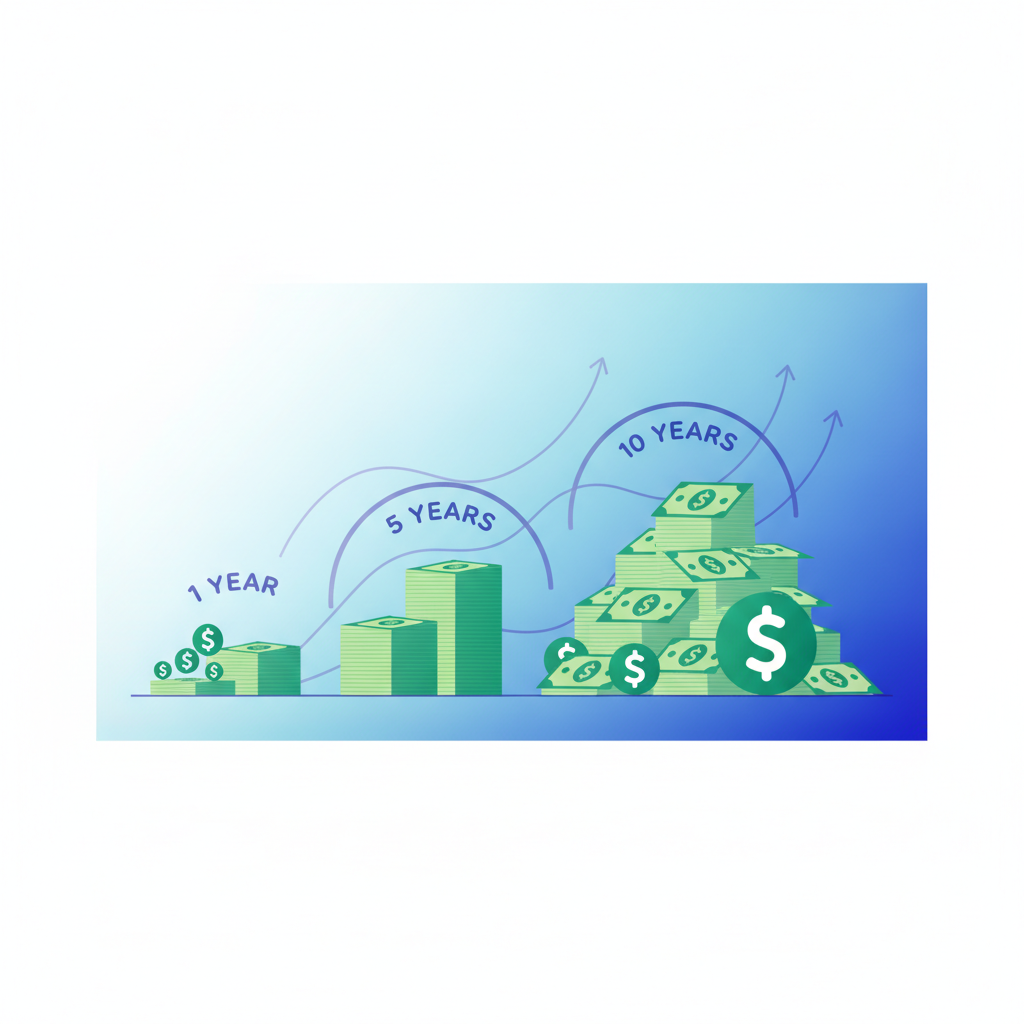
One hundred dollars a month. It is the cost of a few streaming subscriptions, a handful of takeout orders, or one moderate night out. Most people would not call it a life-changing amount. But when you do the math over years and decades, $100 per month produces results that genuinely surprise people.
This article breaks down exactly what happens to $100 per month across three scenarios: plain savings, high-yield savings, and investing. No hype, no speculation. Just the numbers.
The Pure Savings Math: No Interest, No Investing
If you put $100 per month into a standard checking account or under your mattress, the math is straightforward multiplication:
- 1 year: $1,200
- 5 years: $6,000
- 10 years: $12,000
That is $12,000 you did not have before. For context, the Federal Reserve's Survey of Consumer Finances found that 37% of American adults could not cover a $400 emergency expense without borrowing. Twelve thousand dollars is a legitimate emergency fund that covers 3-4 months of essential expenses for many households.
The problem with plain savings is not the outcome. It is the opportunity cost. Your money sits there, slowly losing purchasing power to inflation (averaging 2-3% annually). Over 10 years, that $12,000 in a zero-interest account buys what roughly $9,700 would buy today. You preserved the money, but you lost ground against rising prices.
With High-Yield Savings: The Safe Compounder
A high-yield savings account (HYSA) currently offers around 4-5% APY. These are FDIC-insured, meaning your money is protected up to $250,000 per account. Using a conservative 4.5% APY, here is what $100 per month produces:
- 1 year: $1,228 (you earned $28 in interest)
- 5 years: $6,715 ($715 in earned interest)
- 10 years: $15,057 ($3,057 in earned interest)
The interest earned in the first year seems almost trivial. Twenty-eight dollars. But notice what happens over time. By year 10, you have earned over $3,000 in interest, money generated entirely by money you already saved. That is compound interest working, quietly and predictably.
Compound interest is the eighth wonder of the world. He who understands it, earns it. He who does not, pays it.
For money you might need within 1-3 years, a high-yield savings account remains the most rational choice. It is liquid, insured, and earns meaningfully more than a standard account. Think of it as where your emergency fund and short-term goals should live.
With Investing: Where Compound Growth Gets Serious
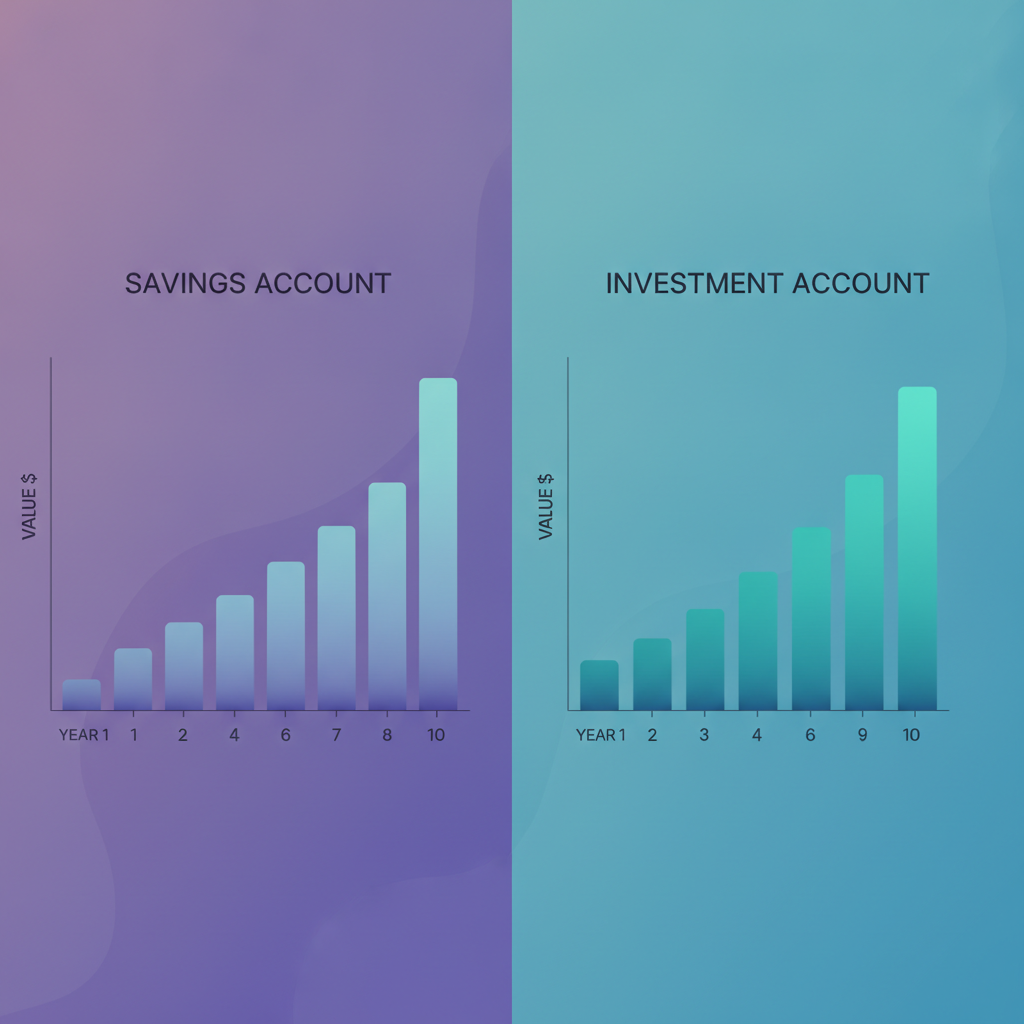
If you invest $100 per month in a broad market index fund (like an S&P 500 fund), historical data gives us a reasonable expectation of roughly 7% average annual return after inflation. Using the future value of annuity formula (FV = PMT x [((1 + r)^n - 1) / r]), where PMT is $100, r is 0.5833% monthly (7% / 12), and n is the number of months:
- 1 year (12 months): $1,239 ($39 in gains)
- 5 years (60 months): $7,159 ($1,159 in gains)
- 10 years (120 months): $17,308 ($5,308 in gains)
At 10 years, your total contributions are $12,000, but your account holds $17,308. That extra $5,308 came entirely from market returns compounding on themselves. You earned more than five thousand dollars for doing nothing beyond consistently depositing $100 each month.
Important caveat: unlike the savings account scenario, investing involves real volatility. In any given year, the market might be up 25% or down 30%. The 7% average is a long-term mean, not a smooth line. If you need the money within 3-5 years, investing in equities carries meaningful short-term risk.
The Complete $100/Month Comparison Table
Here is every scenario side by side, so you can see exactly how the paths diverge:
| Timeframe | You Contribute | Savings (0%) | HYSA (4.5%) | Index Fund (7%) |
|---|---|---|---|---|
| 1 Year | $1,200 | $1,200 | $1,228 | $1,239 |
| 3 Years | $3,600 | $3,600 | $3,847 | $3,993 |
| 5 Years | $6,000 | $6,000 | $6,715 | $7,159 |
| 10 Years | $12,000 | $12,000 | $15,057 | $17,308 |
| 20 Years | $24,000 | $24,000 | $37,821 | $52,093 |
| 30 Years | $36,000 | $36,000 | $73,453 | $122,709 |
The 30-year row is where compound growth becomes almost absurd. You contributed $36,000 over three decades. The index fund scenario gives you $122,709. More than $86,000 of that total came from investment returns alone. That is money earned by money, not by labor.
Why Consistency Matters More Than Amount
The most common objection to saving $100 per month is "that is not enough to matter." The data says otherwise, but there is a subtler point worth making: the habit of consistent saving matters more than the specific dollar amount.
A person who saves $100 every single month for 10 years will nearly always end up wealthier than someone who sporadically saves $500 whenever they "have extra money." The sporadic saver might deposit more in total, but behavioral research consistently shows that irregular saving leads to irregular withdrawals. The money comes and goes.
Automation eliminates the decision fatigue that kills savings plans. When $100 leaves your account on the 1st of every month before you have a chance to spend it, saving stops being a choice you make 12 times a year and becomes a default behavior. This is the "pay yourself first" principle, and the data behind it is overwhelming.
A study from the National Bureau of Economic Research found that people who automated their savings contributions were 80% more likely to still be saving after 12 months compared to those who transferred manually. The amounts were similar. The consistency was not.
The Cost of Waiting: What If You Started 5 Years Ago?
This is the part that usually stings. If you are reading this at age 30, thinking about starting, here is what you would already have if you had started at 25:
- Plain savings: $6,000 already saved
- HYSA at 4.5%: $6,715 (an extra $715 earned passively)
- Index fund at 7%: $7,159 (an extra $1,159 you did not work for)
The gap seems modest after just 5 years. But the compounding effect accelerates. A person who starts at 25 and saves $100/month in an index fund until age 65 accumulates approximately $264,000. Someone who starts the same habit at 30 accumulates roughly $192,000. Those five years of delay cost $72,000 in lifetime wealth. Not because of the $6,000 in missed contributions, but because those early dollars had the longest time to compound.
The best time to start was five years ago. The second best time is this month. Not next month. Not January. This month.

How to Actually Make $100/Month Happen
Knowing the math is the easy part. The hard part is finding $100 that you do not currently have committed elsewhere. Here are approaches that work without requiring a raise or a side hustle:
The Audit-First Approach
Before cutting anything, track every dollar you spend for one full month. Most people discover $150-300 in spending they were not consciously choosing: unused subscriptions, convenience purchases they would not repeat, recurring charges from services they forgot they had. An AI-powered tracking tool can surface these patterns automatically, often identifying savings you overlooked.
The Substitution Method
Rather than eliminating categories (which feels like deprivation), substitute within them. Coffee at home 3 days a week instead of 5 at a shop saves $40-60/month without "giving up coffee." Cooking one extra dinner at home per week saves $50-80/month without "never eating out." You are not sacrificing. You are redirecting.
The Automate-and-Forget Strategy
Set up a $100 automatic transfer on the day after payday. Most people adapt to having $100 less in their checking account within one to two months. It is the financial equivalent of adjusting to a new pair of shoes: briefly noticeable, then invisible.
Tools like kNexo make this easier by tracking your spending via WhatsApp and showing you exactly where your money goes each week. When you can see the patterns, finding $100 becomes a problem with an obvious answer rather than a vague aspiration.
What $100/Month Actually Buys You
Beyond the raw numbers, consistent saving produces something harder to quantify: financial confidence. A person with $6,000 saved approaches life differently than a person with $0 saved. They negotiate salaries more assertively because they can afford to walk away. They handle car repairs without panic. They sleep better.
The goal-setting research is clear on this: financial security is not a number, it is a felt experience. And that experience starts changing well before you reach any conventional target. Most people report feeling meaningfully less financial stress once they cross the $2,000-3,000 threshold in accessible savings, enough to handle the most common unexpected expenses without debt.
One hundred dollars a month gets you there in 20-30 months. Less than three years to fundamentally change your relationship with money.
The Gamification Factor: Staying Motivated Over Years
Saving $100 per month is not intellectually difficult. It is behaviorally difficult. The challenge is not understanding compound interest. It is doing the same boring thing month after month while the results remain invisible in the early stages.
This is where gamification earns its place. When your savings app gives you a streak counter that tracks consecutive months saved, missing a month costs you something psychologically. When you hit a milestone ($1,000 saved, $5,000 saved) and receive visual feedback, the abstract future benefit becomes a concrete present reward.
Behavioral economists call this "making the invisible visible." Compound interest is a long-term phenomenon. Streaks, badges, and progress bars are immediate. They bridge the gap between action and payoff that causes most savings plans to die in month four.
Start With the Math. Stay for the Habit.
The numbers in this article are not projections or promises. They are arithmetic. Put in $100, earn a return, let the returns earn returns. The formula has not changed in centuries and it does not require luck, timing, or financial sophistication.
What it requires is showing up. Every month. Automatically, if possible. The 52-week savings challenge teaches the same principle at a smaller scale: consistency is the variable that matters most.
Whether you choose a savings account, a high-yield savings account, or an index fund depends on your timeline and risk tolerance. But the decision to start, that is the one that changes your trajectory. Everything in this article flows from one choice: $100, once a month, starting now.
Frequently Asked Questions
Is saving $100 a month enough to build wealth?
Yes. Invested in a broad index fund averaging 7% annual returns, $100 per month produces roughly $17,300 in 10 years, $52,000 in 20 years, and over $122,000 in 30 years. The key is consistency and starting early. The amount matters less than the habit of regular contributions combined with compound growth.
What does saving $100 a month look like after 5 years?
After 5 years, $100 per month in a regular savings account gives you $6,000. In a high-yield savings account at 4.5% APY, you would have roughly $6,715. Invested in an S&P 500 index fund averaging 7% annually, the same contributions grow to approximately $7,159. The difference between saving and investing becomes more dramatic over longer time periods.
Should I save $100 a month or pay off debt first?
If your debt carries interest above 7-8% (most credit cards), paying it off first delivers a guaranteed return higher than typical investments. A practical approach: build a small emergency buffer of $500-1,000, aggressively pay down high-interest debt, then redirect those payments into savings and investing.
Where should I put $100 a month for the best return?
It depends on your time horizon. For money you may need within 1-2 years, a high-yield savings account (4-5% APY) keeps it safe and accessible. For 5+ year goals, a low-cost index fund historically delivers 7-10% average annual returns. For retirement specifically, contribute to a Roth IRA or 401(k) to add tax advantages on top of the growth.
Make saving $100/month automatic
kNexo tracks your spending via WhatsApp, finds the $100 you did not know you had, and turns saving into a streak you do not want to break.
Start free